If You’re Not Managing Work Tasks, You’re Not Managing the Project
From cost estimating to project scheduling, and other project control discussions.
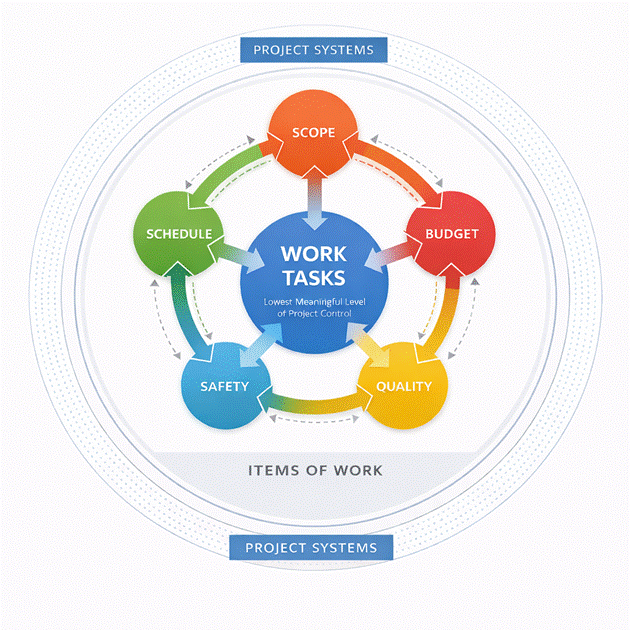
Spend just a few days on any jobsite and one truth becomes unmistakable: scope, budget, schedule, safety, and quality are inseparable. Each constraint influences the others continuously, often in ways that are not immediately visible. Attempting to manage any one of them in isolation is not just ineffective, it is one of the most consequential risks a construction professional can take.
The evaluation and management of these constraints is most effective at the work-task (activity) level, not at the project level. Project outcomes are merely the aggregation of thousands of individual decisions and actions made in the field. What happens at the overall project level depends on outcomes at the item-of-work level, which in turn are driven by how individual work tasks are planned, resourced, sequenced, and executed. In construction, the work task represents the lowest meaningful level of control for influencing performance, managing risk, and achieving predictable results.
A construction project is not made up of a linear checklist of work tasks. It is a complex system composed of many interrelated and integrated subsystems. Labor, equipment, materials, means and methods, site conditions, and human decision-making interact dynamically, often producing second- and third-order effects. Understanding and managing these interactions requires a systems-thinking perspective, where cause and effect are evaluated holistically rather than in isolation.
This systems-based approach is emphasized throughout the Interactive Webbook.
The webbook reinforces the idea that projects must be understood as collections of interconnected systems, each made up of multiple components operating simultaneously. This perspective is fundamental to how effective practitioners plan, manage, and deliver heavy civil construction projects, regardless of size, complexity, or delivery method.
In the field, success is rarely about optimizing a single metric. It is about aligning scope, budget, schedule, safety, and quality at the task level, where real work occurs, and real risks are created, or mitigated.