White Paper: Reframing Construction Planning as the Design of Construction Means and Methods

From project planning, cost estimating, scheduling, and other project control discussions.
Purpose:
This white paper provides construction professionals (project managers, superintendents, project engineers, field engineers, and others) with a practical framework for understanding planning as execution design, not merely schedule creation, and demonstrates how rigorous planning improves project reliability and reduces risk.
Executive Summary
Many construction projects fail not because of poor schedules but because planning is misunderstood.
In most organizations, planning is equated with producing schedules, estimating durations, and generating charts. But schedules are only a representation of the execution plan, not the plan itself.
This white paper presents a reframing of construction planning:
Construction planning is the disciplined and iterative design of construction means and methods under multidimensional constraint environments.
This paper provides:
- A conceptual model showing how planning decisions affect project outcomes
- A set of formal propositions for robust planning
- A heavy civil case illustration demonstrating practical application
- Visual diagrams for guidance and industry adoption
1. The Industry Problem
In many projects:
- Planning is reduced to software proficiency
- Durations are based on guesses rather than modeled productivity
- Constraints are treated as secondary considerations
- Risk is tracked in spreadsheets rather than actively managed
The consequences include:
- Unrealistic float in schedules
- Critical path instability
- Forecast inaccuracies
- Poorly managed contract changes, claims, and disputes
The root cause is planning without a focus on execution design.
2. The Core Principle
Engineering defines what will be built.
Planning defines how it will be built.
As a principle, planning does not document how work will be done, it engineers how work can be done reliably under constraint.
Construction planning can be viewed as the disciplined and iterative design of construction means and methods under constraint, establishing the execution logic and analytical foundation required for reliable delivery.
Construction planning involves the design and analysis of:
- Work tasks (activities), and their durations
- Resource selection and optimization
- Work sequencing
- Staging, access, and logistics
- Alternative construction methods
- Constraints
- Coordination of work across different parties and resources
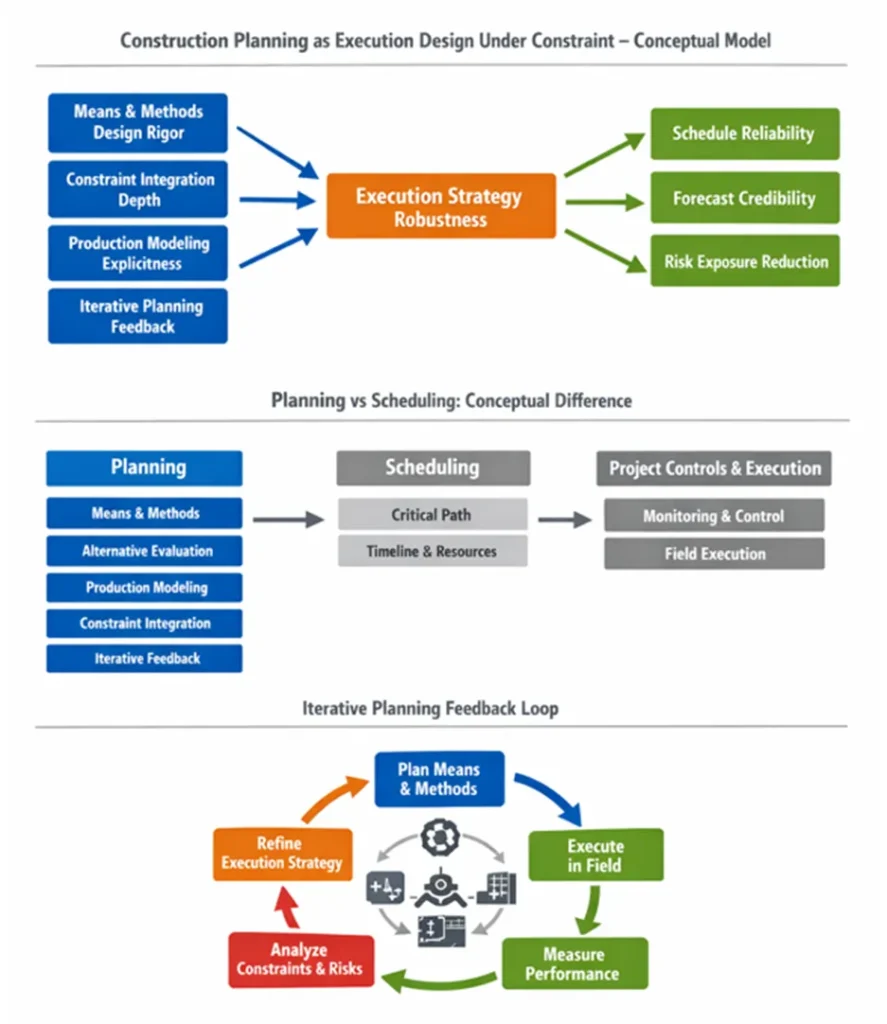
Planning is therefore design of construction means and methods. Scheduling is simply a temporal representation of the plan. Project controls measure performance, and field execution validates assumptions.
3. Conceptual Model
Effective construction planning integrates four primary elements:
- Design Rigor for Means and Methods – How thoroughly alternative execution strategies are considered and evaluated
- Integration of Constraints – How deeply time, spatial, resource, regulatory, financial, and physical constraints are included in the plan
- Explicit Production Modeling – Whether durations are derived from productivity analysis rather than assumed averages
- Iterative Feedback from Field Execution – How field performance data is used to refine and improve plans
These elements together determine:
- Execution Strategy Robustness – A coherent, optimized, and buildable construction plan
- Schedule Reliability – Stability and predictability of planned work
- Forecast Credibility – Accuracy of time and resource predictions
- Risk Exposure Reduction – Mitigation of delays, conflicts, and claims
4. Planning Under Constraint
All construction work occurs under a range of constraints:
- Time limitations – time windows, and milestones
- Spatial restrictions on site
- Resource availability
- Safety requirements
- Contractual obligations
- Financial constraints
- Regulatory and environmental constraints
Professional planning skill is revealed when these constraints conflict. Planning is the design and optimization of construction means and methods within these boundaries.
5. Production Modeling: The Missing Discipline
Project durations should be based on modeled production rates rather than arbitrary assumptions:
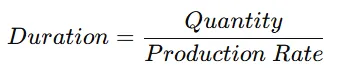
Production rate depends on:
- Crew size and skill
- Construction equipment availability and capacity
- Work methods
- Learning curve effects
- Expected downtime
- Exposure to constraints
Schedules based on assumed durations are fragile and prone to delays.
6. Heavy Civil Case Illustration
Project: Urban highway widening involving:
- Cut-and-fill earthwork
- Utility relocation
- Mechanically stabilized earth (MSE) wall construction
- Restricted right-of-way
Schedule-Centric Planning Approach:
- Durations assumed
- Utilities not modeled
- Critical path unstable
- Claims increased
Execution-Design Planning Approach:
- Alternative haul road phasing modeled
- Balanced earthwork optimized
- Strategies for relocating utilities prepared early
- Construction equipment fleet matched to corridor width
- Production rates modeled to reflect specific site conditions, and field feedback incorporated
Outcome of Robust Execution-Design Planning:
- Reduced schedule variance
- Stable critical path
- Predictable cash flow
- Lower risk exposure
This example demonstrates the impact of rigorous planning vs the case of schedule-centric planning approach.
7. Practical Guidance
To strengthen planning capability:
- Train construction professionals in the design of construction means and methods
- Require explicit productivity modeling for all major work packages
- Conduct constraint mapping workshops
- Embed risk mitigation into sequencing decisions
- Establish iterative re-planning cycles based on field performance
Planning must be treated as a technical discipline, not an administrative task, or as one of those tasks to be performed by young engineers that are still learning the know-how of project planning.
8. Conclusion
Planning as an Engineering Discipline
Construction planning must be reclaimed as an engineering discipline.
It is not the act of producing schedules.
It is not the manipulation of software.
It is not the documentation of assumed durations.
Planning is the disciplined and iterative design of construction means and methods under constraint.
It defines how the work will be constructed, why it will be constructed that way, and on what analytical basis performance expectations are built. It integrates sequencing logic, production modeling, constraint analysis, and alternative evaluation into a coherent execution strategy that can withstand the realities of field conditions.
The ultimate goal of planning is to rigorously evaluate alternative means and methods and deliberately select the construction strategy that optimizes cost, time, and reliability while treating safety and quality as non-negotiable constraints. It is the process by which uncertainty is reduced before crews mobilize, equipment is deployed, and resources are committed.
Schedules communicate the plan.
Project controls measure the plan.
Field operations validate the plan.
But planning engineers the plan.
Projects that treat planning as an administrative task inherit instability, shifting critical paths, and reactive management. Projects that treat planning as execution design gain predictability, credible forecasting, and controlled risk exposure.
If the industry seeks fewer disputes, more reliable delivery, and stronger performance outcomes, the solution does not begin with better scheduling software. It begins with elevating planning to its proper role, as the engineering foundation of project execution.
Planning Infographics