Do You Really Know Everything Your Job Requires and Do You Understand the Four Types of Knowledge and the Risk of Not Knowing?

From cost estimating to project scheduling, and other project control discussions.
No one knows everything. But the risks created by what we don’t know can be managed—if we understand the four types of knowledge and the risk of not knowing.
In today’s fast-paced, complex work environments, ignorance isn’t bliss—it’s risk. Awareness, however, turns risk into opportunity. The deeper we go down the knowledge rabbit hole, the more we realize how little we actually know—and why intentional learning matters.
Early in my career as a field engineer, I often thought, “I know everything I need at this stage, and I have all the resources I need.” As I progressed, I quickly realized how wrong that assumption was. Doing my job well required not only learning new things, but also reinforcing what I already knew and identifying gaps I hadn’t even realized existed. As such, I became a lifelong learner.
We wrote the Interactive Webbook on Heavy Civil Construction Materials and Methods to help reinforce what young heavy civil construction professionals already know, fill gaps in their knowledge, help them uncover hidden insights, and reveal blind spots before they become problems.
Let’s explore these four areas of knowledge and make the case for why each one matters. The framework originally developed by Johari and subsequently made popular by Rumsfeld offers a useful analytical lens, categorizing knowledge into four quadrants: known knowns, known unknowns, unknown knowns, and unknown unknowns.
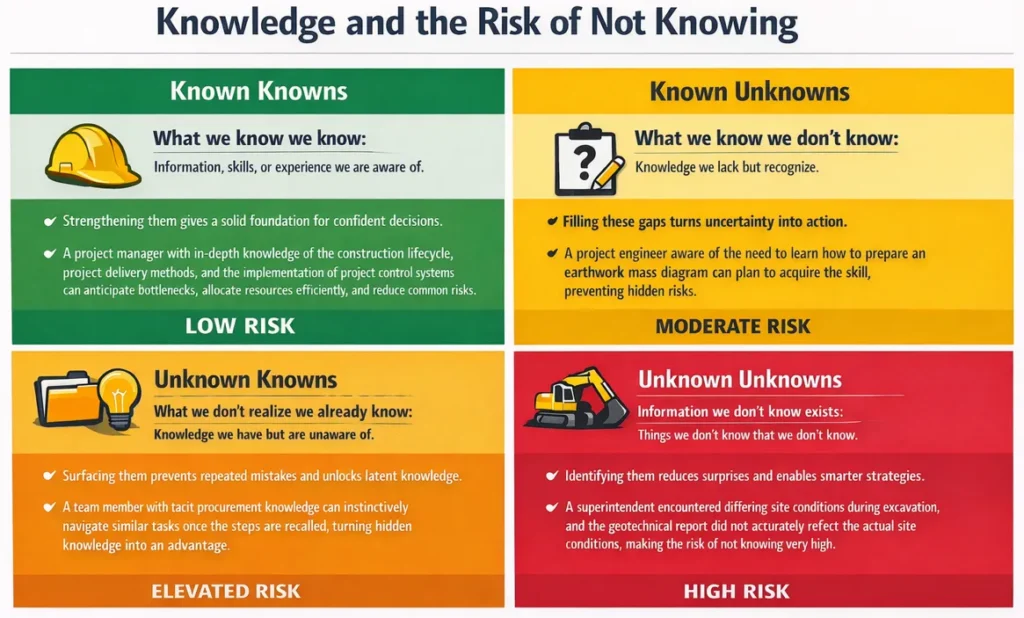
Ask yourself: Are you intentionally moving knowledge from the unknowns to the knowns, and do you really know all that you need to know about everything that your job requires?